
Introduction to Highly Effective People
Highly effective people stand out because they consistently achieve success while building strong, positive relationships. What sets them apart is not just their drive to win, but their commitment to creating situations where everyone involved can benefit. This win win mindset is at the heart of their approach to life and work. Rather than seeing every interaction as a competition, highly effective people look for ways to collaborate and find mutual benefit, knowing that true success is sustainable only when it is shared.
The habits of highly effective people, especially the habit to think win, foster an environment where trust and collaboration thrive. By seeking win win solutions, they build relationships that are resilient and productive, both in their personal lives and in their professional partnerships. This mindset transforms challenges into opportunities for growth, and competition into creative problem solving. When you adopt a win win approach, you not only achieve your own goals but also help others succeed, leading to a cycle of ongoing, sustainable success.
In a world where many still believe that for one person to win, another must lose, highly effective people prove that the real alternative is to seek outcomes where everyone can walk away satisfied. This habit is not just about being nice—it’s about building a foundation for long-term achievement and healthy, supportive relationships.
Summary of Habit 4 of 7 Habits
Habit four is all about creating a win-win situation. Covey describes the significance of a win-win situation that leads to mutual benefit because if one side gets the edge over the other, it creates a win-win situation that is good for one side but bad for the other.
For the habit of highly effective people, he lays emphasis that win-win makes things cooperative instead of competitive because both parties are mutually benefited. Covey further explained that a win-win attitude has the outcome of three important character traits:maturity, integrity and an abundance mentality.
Covey, in this effective people’s habit, also explains that for a win-win, you not only have to be empathic but also confident enough; otherwise, the win-win situation might not be possible.
Human relationships are often dominated by comparisons and competition from the early years of our lives.
We think about succeeding in terms of someone else losing – if I win, you lose, if you win, I lose. It’s the mentality of fighting for a larger piece of the pie. But what if both of us could eat some of the pie and be fully satisfied?
This is what habit 4 thinks winning is all about – transforming life into a cooperative field instead of a competition using the best habits.
Think Win-Win

The idea behind “think win-win,” i.e., habit 4 is to have the courage to seek mutual benefit from all human interactions instead of having winners on the one side and losers on the other.
Achieving a “win win” way of interacting with others is more than just being nice or looking for a quick fix. A win-win solution isn’t easy.
When it is impossible to reach a win-win solution, you should suggest a “No Deal.” This has remained the habit of highly effective people.
What is Habit 4?
TThink win-win isn’t about being nice, nor is it a quick-fix technique. It is a character-based code for human interaction and collaboration.
Most of us learn to base our self-worth on comparisons and competition. We think about succeeding in terms of someone else failing–that is, if I win, you lose; or if you win, I lose. Life becomes a zero-sum game. There is only so much pie to go around, and if you get a big piece, there is less for me; it’s not fair, and I’m going to make sure you don’t get any more. We all play the game, but how much fun is it really?
Understanding Interdependent Realities
In life, most of our greatest achievements and challenges involve other people. Whether at work, at home, or in society, we operate in interdependent realities—situations where our success is closely linked to the success of others. Recognizing this is key to developing a win win mindset. Instead of viewing life as a zero sum game, where one person’s gain is another’s loss, highly effective people understand that collaboration and mutual benefit are the only real alternatives for lasting success.
When you approach relationships and negotiations with the idea that everyone’s needs matter, you open the door to creative problem solving and better outcomes for all involved. This is the essence of the win win solution: balancing courage and consideration, and seeking answers that respect both your own needs and those of your partners, clients, or colleagues. In interdependent situations, trying to win at the expense of others often leads to lose lose outcomes in the long run—damaged trust, broken relationships, and missed opportunities.
By embracing interdependence, you shift your focus from competition to collaboration. You start to see that your own success is amplified when you help others succeed. This mindset not only builds stronger teams and partnerships but also creates a sense of shared purpose and achievement that is far more rewarding than any short-term win lose victory.
Why is Habit 4 so Important?
Habit 4 has a profound impact on the quality of your relationships. It helps build long-lasting trust that will make all interactions a lot easier.
It will bring more “luck” in your life, too.
In Covey’s terms, the Fourth Habit helps make deposits in the emotional bank account of the person you are dealing with.
Working with a mentality of abundance can change how you see work and life in general.
Rather than feeling envious of someone else’s success, you will genuinely be energized by it.
It takes conscious practice so start today :)
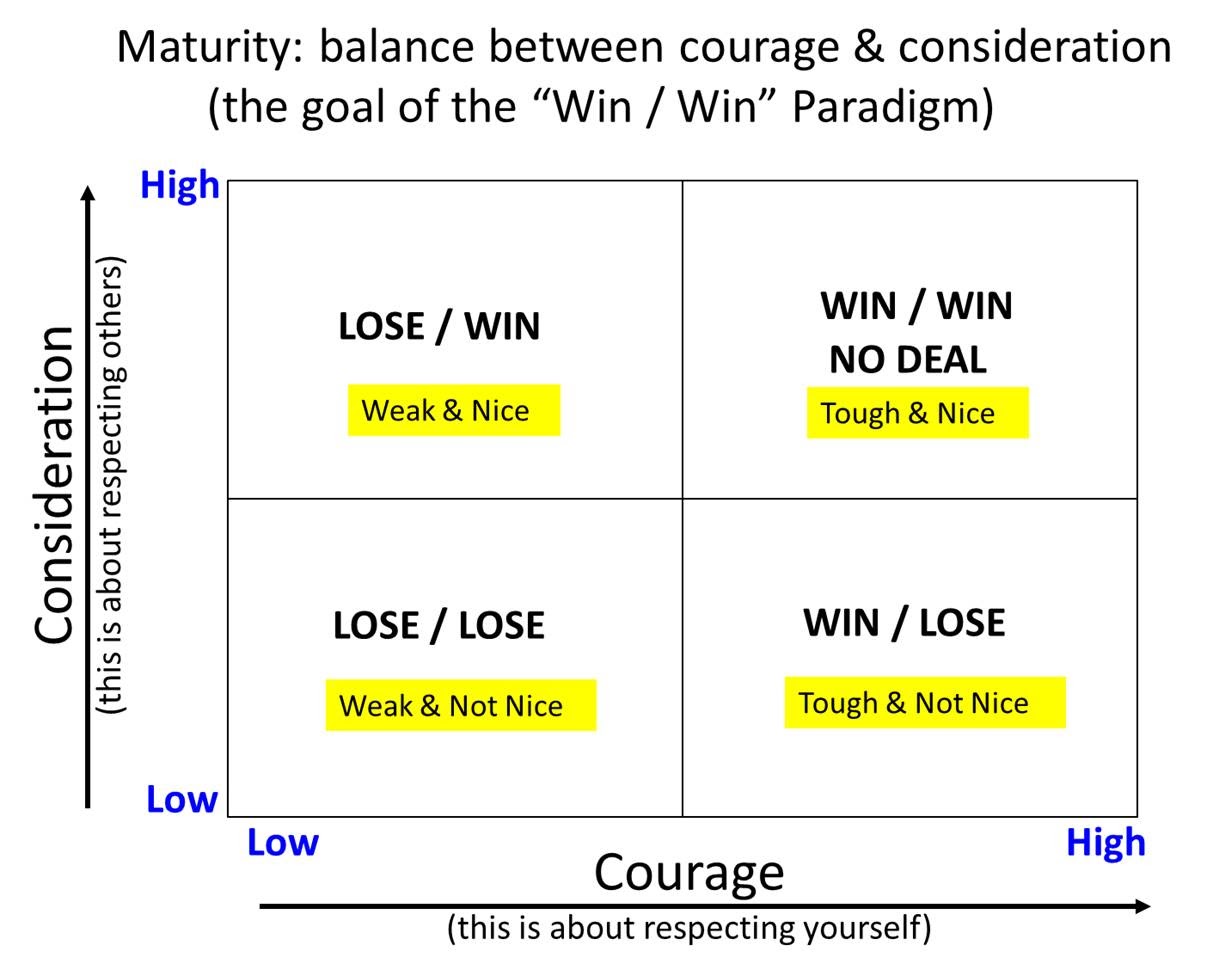
The Six Paradigms of Habit 4
The goal in habit4 is to think win-win and acknowledge the win-win paradigm as much as possible. It is important to identify when and how to use it for high productivity. Let us examine the six paradigms of habit 4 and how effective people use the right mindset to gain success in life:
1. The Win-Win: Everybody is Happy
The Think win-win resolution can be challenging and may seem impossible sometimes. It is the habit of highly effective people to engage in longer dialogues, even when it seems like you have reached the endpoint. Real maturity is listening to others carefully to comprehend their goals and perspective. It then follows by expressing your point of view. The end goal is to solve problems that neither party could have done on their own.
2. The Win-Lose: I Beat You
The Win-Lose paradigm concludes everything as a competition. It makes it seem that a person’s success must come regardless of the impact it may have on others. An authoritarian style is used by leaders who have a win-lose mentality. This mindset usually concerns authority, power, personality, or status to achieve what is desired.
Most people have an entrenched Win/Lose mentality reinforced through several life experiences. Schools, sports, and sibling rivalries are thought to be win/win examples of the win/lose paradigm. Although there might be situations where a win/lose approach is relevant, cooperation is a better approach than the competition.
3. The Lose-Win: You Win, I’ll Accept It
The people with the Lose-Win paradigm are inclined to move to the way of lesser resistance. They want to acquire acceptance from other people and are intimidated by others’ strengths. They shy away from expressing their feelings and wants. Leaders with this mindset or paradigm have an indulgent and permissive leadership style.
With this mindset, people suppress a lot of their emotions which can result in bursting out anger or resentment. Sometimes, it can affect the nervous, circulatory, and respiratory systems. Recognizing these situations is crucial for understanding the habits of highly effective people.
4. The Lose-Lose: Nobody Wins
When two people with a Win-Lose paradigm encounter each other, their attitudes can result in nobody winning. With such a mindset, an individual may be willing to take the hit to ensure the other person is losing. This paradigm results from getting so concerned about the fall of your opponent that you become blind to even your well-being.
You may develop a Lose/Lose paradigm if you are very dependent and have no personal direction. This means you think that if you are unhappy, then others should feel the same.
5. Win: Only You Win
A Win paradigm is different from a win-win or Win-Lose because it is concerned with only your outcome. If you possess a win mentality, you want to achieve your goals regardless of whether the other person loses or wins. It is the real alternative to the survival of the fittest mentality. It is the habit of highly effective people to take care of themselves, but you also expect others to do the same.
6. Win-Win: Valuing the Relationship
When it’s clear that two parties have entirely different goals, it can save a lot of problems to forgo a deal. The relationship can be kept healthy to collaborate on something different in the future.
With the win-win paradigm, you are inspired to find the right solution that benefits all the parties. If that doesn’t work, you can walk away from the deal, realizing that the two parties’ values do not align.
The No Deal option helps you pursue negotiation and will help you to consider that forcing a deal will only result in unwanted problems. Therefore, it is the habit of highly effective people to have no deal rather than having a conflicting deal.
Long-Term Success
The true power of the win win habit lies in its ability to create long-term, sustainable success. While a win lose approach might deliver quick results, it often comes at the cost of trust, goodwill, and future opportunities. Highly effective people know that the most valuable relationships and achievements are built over time, through consistent integrity, fairness, and a genuine desire for mutual benefit.
A win win mindset encourages you to look beyond immediate gains and focus on building a foundation for future collaboration. When people know you are committed to fair outcomes and value their needs as much as your own, they are more likely to trust you, support your goals, and seek you out as a partner. This leads to a positive cycle where everyone involved is motivated to contribute their best, resulting in greater creativity, innovation, and shared success.
Sustainable success is not about getting the biggest piece of the pie today—it’s about ensuring there’s enough for everyone, now and in the future. By practicing the fourth habit and thinking win win, you invest in relationships and solutions that stand the test of time, making you not just a winner in the moment, but a leader who inspires lasting loyalty and respect.
Key Takeaways of Habit 4
- A win-win situation helps to develop humility in you. If you rely on others for your success, it creates a sense of humility that enables you to find a mutual benefit situation.
- Win-win satisfies both parties because they believe neither of them is a winner nor a loser. This level of satisfaction enables them to work together in the future. In fact, it is the habit of highly effective people to achieve success by working together.
- The win-win strategy creates an atmosphere for both parties to find the solution that benefits them because if they don’t, one has to compromise for others.
- Win-win lets you identify humanity for others because when you become familiar with people who also have goals like you, it helps you understand them better.
- With win-lose, you can get the short-term benefit, but with win-win, you ensure that not you but the other party gets what they want, which makes both parties satisfied. The habit of highly effective people is that they want to succeed along with others.
- Win-win makes you assertive because it not only enables you to state what you want but also allows you to consider the needs of others. A prominent habit of highly effective people is to think of the needs of others along with theirs.
Conclusion on Habit 4 Think Win
Habit 4, Think Win Win, is more than just a strategy—it’s a way of life that transforms how you approach every relationship and challenge. By seeking mutual benefit and embracing an abundance mentality, you move beyond the limitations of win lose or lose win thinking. This habit empowers you to achieve your own goals while helping others succeed, creating a ripple effect of trust, collaboration, and sustainable success.
Highly effective people understand that the only real alternative to competition is cooperation, and that the best solutions are those where everyone feels valued and satisfied. By adopting a win win mindset, you not only enhance your own self worth and confidence but also build a legacy of positive, healthy relationships that support your growth for years to come.
As you move forward, remember that thinking win win requires both courage and consideration. It’s about listening, understanding, and being willing to walk away from deals that don’t serve everyone’s best interests. Make this habit a cornerstone of your life, and you’ll find that true success is not just about winning—it’s about making sure everyone involved can win, too.
7 Habits quiz
Many people know the theory but struggle with consistency — you can assess how well you apply the 7 habits with this quiz.
More Posts
5 Best Planners with Daily Time Slots
As writer Annie Dillard says, “How we spend our days is, of course, how we spend our lives.” Well, your day has 24 hours. How many of those hours do you spend chasing...
11 Benefits of Stopping Procrastinating in Your Daily Life
Feeling stuck or under pressure to do more can push you to beat procrastination. For eight years, I've worked hard to beat it. I've written over 500 blog posts, seven books, and made...
8 Bad Financial Habits that You Should Break
Good financial habits are like daily routines that keep you healthy. Just like brushing your teeth or sleeping well. But, many Americans find it hard to manage their money well. Only 43% could...
11 Habits to Help You Have a Productive Week
Starting daily habits can really help you succeed at work. Things like moving, writing, and setting priorities can make you less stressed. They also make you feel better both in your mind and...